

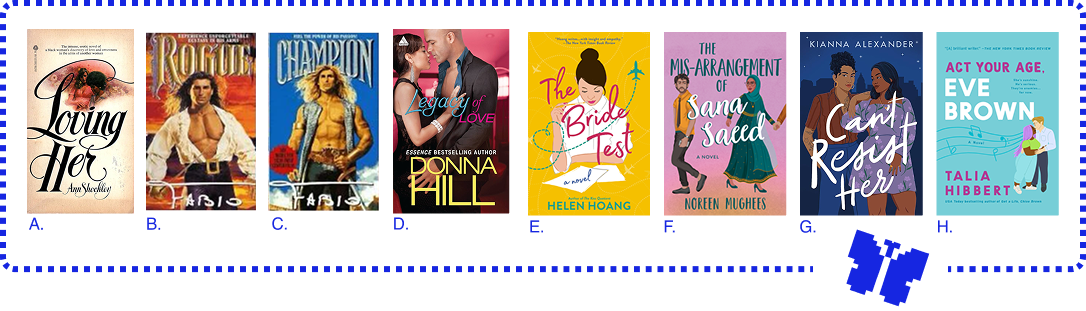
A. Loving Her by Ann Shockley, published 1974 B. Rogue by Fabio & Eugenia Riley, published in 1994 C. Champion by Fabio & Eugenia Riley, published in 1995 D. Legacy of Love by Donna Hill, published 2011 E. The Bride Test by Helen Hoang, published 2019 F. The Mis-Arrangement Sana Saeed by Noreen Mughees, published 2023 G. Can’t Resist Her by Kianna Alexander, published 2022 H. Act Your Age, Eve Brown by Talia Hibbert, published 2021
Maslow didn’t bother consulting us when he created his hierarchy of needs. While we agree with most of it, there’s a glaring omission: the essential need for a fun little book. Yes, rates of reading for pleasure are declining across the US. But reading for a different kind of pleasure shows no signs of slowing down.
Romance novels have remained one of the top genres for the past several years. In 2025, the category sold nearly 44 million units, and Rebecca Yarros’ *Onyx Storm* became the third bestselling print book in the US. Beyond sales alone, romance novels clearly influence culture. BookTok is always swooning over the latest friends-to-lovers story. *Heated Rivalry* needs no introduction. Although the genre is demonstrably popular, it’s still the subject of scorn. Maybe that’s because things that tend to appeal to women are—and have long been—looked down upon. Or maybe it’s because some people just can’t stand when someone enjoys something they don’t. In the business, we refer to them as “people who need to shut up a little bit.”
We’ve spotted romance novels everywhere for a long time. We’re a design studio, so naturally, we started wondering: why do they look like that? Who’s this cover heroine with sunglasses and a red lip? Where’d Fabio go?
Let’s take a little stroll through the history of romance novel covers.
1970s-1990s
It’d be impossible to tell the story of romance novel covers without discussing clinch covers. The 1970s brought major gains for women’s liberation and greater freedom to openly discuss female desire. With that, clinch covers became the new standard in romance marketing.
These covers typically featured a man and woman in states of undress, locked in a tender embrace. To create them, models would pose for a photoshoot, then an illustrator would transform the image into a painted scene with a romantic backdrop like a meadow or, sometimes, a pirate ship. The result was a realistic illustration that made you feel as though you were intruding on a private moment. The origins of this style can be traced back to pulp art, but instead of gracing sensationalized fiction magazines, they found a home in the romance aisle.
Romance covers of this era overwhelmingly featured white, heterosexual couples. But a few outliers subverted the norm of what love was supposed to look like, including Ann Allen Shockley’s 1974 interracial lesbian novel Loving Her (A). The most notable model from this era is Fabio (B). No last name needed. Having appeared on roughly 1300 covers, Fabio is still synonymous with the clinch.
2000s-2020
At the turn of the millennium, publishers tried to find the point of paying illustrators when a photograph would do just fine. Digitally edit the picture, slap some big text over the models and send it to print. So that’s what they did. While illustrations basically disappeared, raunchy and explicit cover scenes did not. As Alice Liang found, “In 2011 and 2012, about a third of the covers still had someone who was at least partially unclothed—almost always the man, alone or with a clothed lover (C). In many cases, covers focused on the couple’s physical intimacy rather than the nature of the plot.” The content of these books ventured beyond romance into full-blown erotica (we all remember what happened when 50 Shades of Grey hit shelves in 2011).
That phase didn’t last forever, though. Alice Liang notes that, “By 2016, only 18% of covers had someone unclothed, falling consistently over the next few years to 10% or less from 2019 on. The clinch doesn’t disappear, per se. It’s that the way the featured couple interacts differs: more covered up and signaling emotional rather than overtly physical intimacy.”
Illustrations re-emerged around 2018 (D). Cartoon figures—or no character illustrations at all—offered a covert way to bring a heavily stigmatized genre to the beach. They still featured romantic signals, like whimsical cursive typefaces and titles that hinted at what was inside. But the cover styles became more subtle and more discreet to carry.
2020-today
More recently, romance novels have settled into a fairly homogeneous visual style: illustrated figures set against sparse backgrounds, often in shades of pink, teal, and purple (E). With their bold colors, high contrast, and minimal detail, these covers feel a lot like our old friend Corporate Memphis. Just like in tech, the style seems less about differentiation and more about appealing to a broad audience. Given the history of romance cover models, that shift isn’t all bad. The characters on today’s covers are no longer overwhelmingly white, passive heroines draped across Fabio-adjacent men. They’re a better reflection of romance readership and what readers actually want: delight, inclusivity, and relatability.
There’s a big lesson here for designers. With some intentional design choices, taboo products like romance novels can become a point of connection for people who once felt excluded from them. But there’s a challenge here, too. How might we create distinction in a sea of sameness? We’re excited to see what comes next. Here’s hoping romance novels continue to evolve without succumbing to AI slop.
Sources:
https://fchornetmedia.com/31808/inside-fullerton/the-evolution-of-romance-novel-book-covers/
https://www.publishersweekly.com/pw/by-topic/industry-news/financial-reporting/article/99417-print-book-sales-rose-slightly-in-2025.html
https://booketic.com/romance-novel-sales-statistics/
https://www.npr.org/2023/06/02/1179850128/even-as-overall-book-sales-are-declining-romance-novels-are-on-the-rise
https://www.mentalfloss.com/entertainment/fabio-facts#inline-text-7
https://www.writersdigest.com/the-billion-dollar-genre-why-romance-writing-matters
https://hazlitt.net/feature/brief-history-clinch
https://bookriot.com/clinch-covers-on-romance-novels/
https://99percentinvisible.org/episode/445-the-clinch/

