

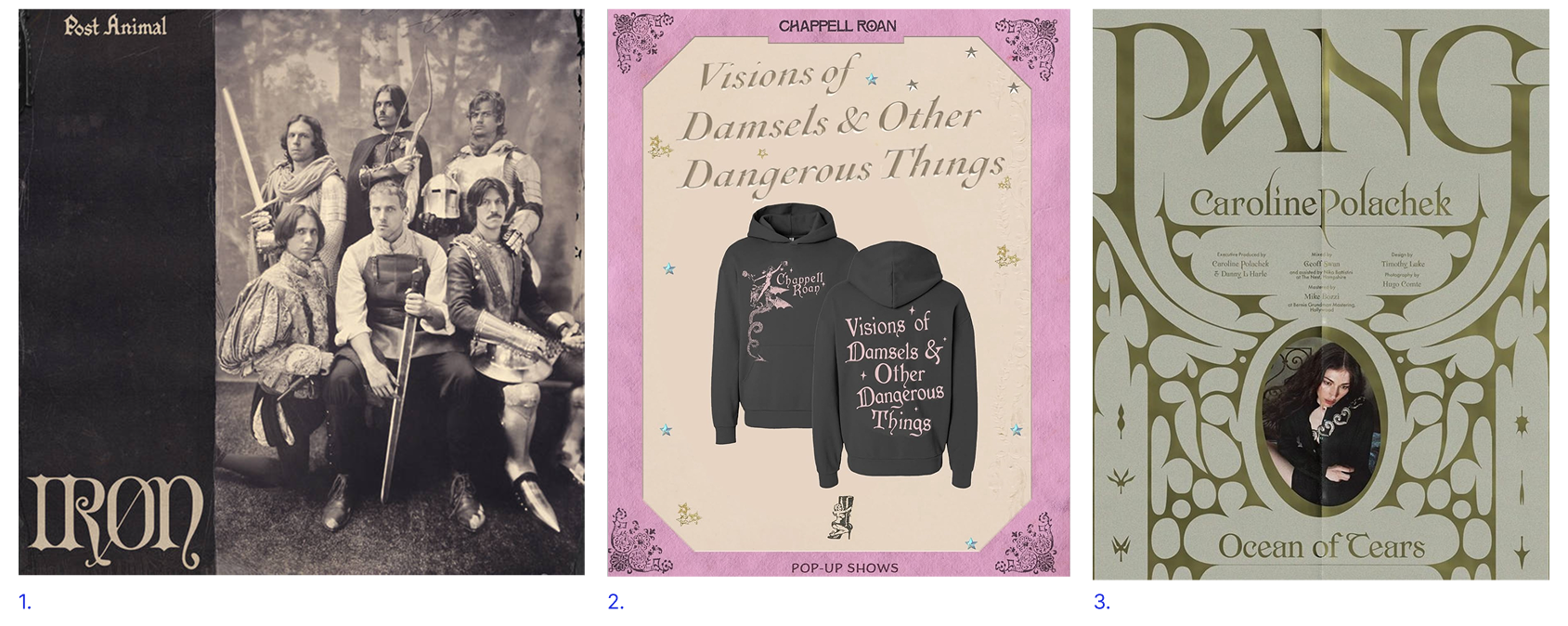
1. Post Animal’s “Iron” album cover, 2025 2. Chappell Roan Visions of Damsels & Other Dangerous Things Tour Merch, 2025 3. Caroline Polacheck “Pang” album art, by Timothy Luke, 2019
Before there were chain emails, there was chainmail. Before the dark web, there were the Dark Ages. Before going viral, there was the plague. If you yearn for the ye olde days of gruel and feudalism, and lament being “born in the wrong generation,” you’re in luck — looks like we’re barreling straight into the past. Current design trends are proof.
Future medieval, affectionately known as castlecore, is back. But this isn’t its first conquest. Don thy armor and sharpen thy blade: we’re tracing the lineage of medieval-inspired design.
Castlecore features heavy blackletter typography, intricate ornamentation, and gothic imagery. It conjures a sense of whimsical mysticism while staying rooted in the past (an era we’ve only glimpsed through illustrated manuscripts). The richness of this style is a logical reaction to the austerity of minimalism, and much darker and more romantic than maximalism. It’s the goth cousin who’s charming and strange.
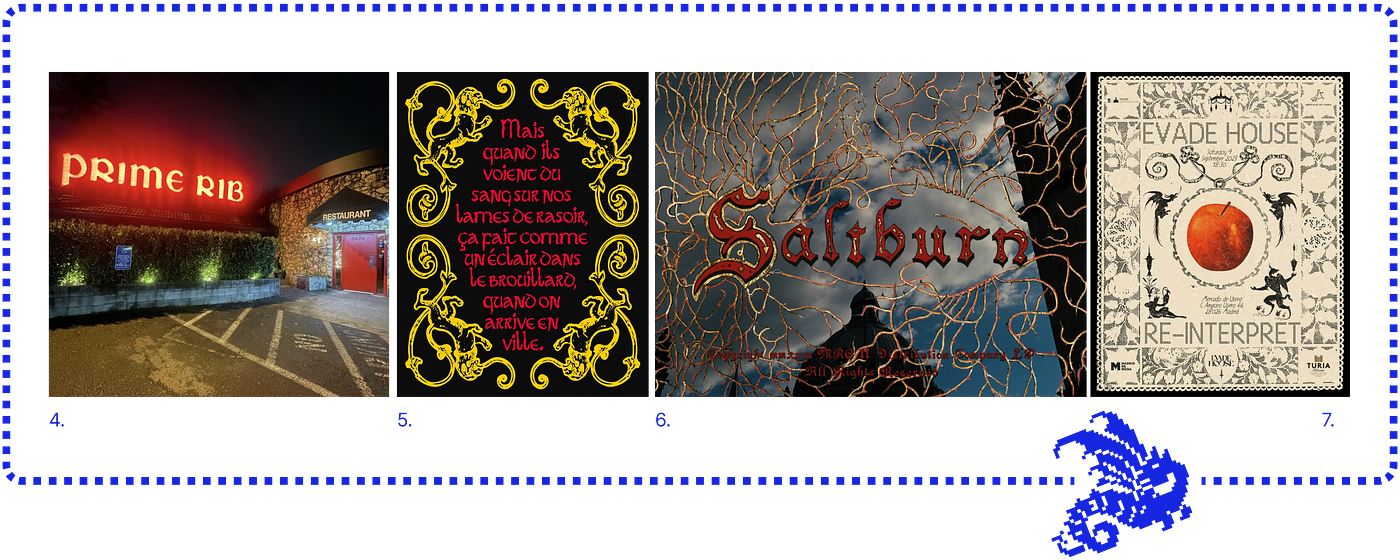
The first modern wave of medieval nostalgia stretched from the mid-1950s to the mid-1970s. Its influence was unmistakable across every cultural touchpoint. Castle motifs, elaborate typefaces, and goblets decorated everything from film to hospitality to suburban architecture. The first Renaissance festival opened in 1963, inviting Americans to literally step into the fantasy. Portland’s own Clyde’s Famous “Prime Rib” sign is likely a well-preserved (and beloved) relic of the era. As the CARI Institute points out, this revival came filtered through the period’s defining lens — bright, kitschy, and playful. It mirrored the mood of the time. In the wake of World War II, America was settling into a new age of optimism and suburban comfort. However, this optimism didn’t last. Postwar prosperity gave way to growing unrest and the Vietnam War soon reignited anxiety. Medieval fantasy (emphasis on “fantasy”) offered a nostalgic escape to an imaginary world that felt simpler, slower, and safely mythical.
Fast forward to the 1990s and a new context. Between events like the LA Riots, lingering moral fears of the Satanic Panic, and uncertainty about the coming millennium, things felt heavy. How did Americans cope with this cultural weight? Medieval revival, of course. But this time, with a Shakespearean flair — because unless you’re a history nerd, Renaissance styles look close enough to medieval ones to lump them together. Couture collections and runway shows drew on Elizabethan fashion. Leonardo DiCaprio changed our lives forever in 1996’s Romeo + Juliet. And Renaissance festivals were so popular that corporations suddenly wanted a piece of the mince pie. By the late ’90s, medieval revival was a full-blown court. The fantasy faded with the turn of the millennium, but like any good prophecy, it was destined to return.
Cue the castlecore of today. Since everything’s fine and nothing is bad, there’s clearly no reason it’s having a resurgence. Just kidding! These days, TikTok is full of tutorials for making chainmail and styling bodices. Medieval Times offers a year-round escape into ye olde entertainment and excellent Instagram photo opportunities. The aesthetic shines brightest in music, from Teenage Engineering’s gorgeous little synth to Chappell Roan taking the stage in full armor. This trend coincides with a fresh hunger for fantasy in pop culture. House of the Dragon dominates streaming. A Court of Thorns and Roses tops bestseller lists. Baldur’s Gate 3 breaks gameplay records. Together they signal a collective craving for escape. Design-wise, castlecore reflects this yearning and darkens it. It’s expressed through moody palettes; it’s heavy and tinged with pessimism. Maybe that’s no coincidence. In an age of AI-generated everything, even a pulled-back application of blackletter feels like a small act of resistance and a return to craft, to imperfection, to the human hand. As Elizabeth Goodspeed says, “It’s a bit of horseshoe theory: if you go far enough into acid graphics, you accidentally come back around to the 15th century. Pixels become cross-stitched tapestries; Fraktur stops looking like a trendy headline font and feels like a clerical proclamation again.”
What does the future hold? Who knows. For now, we’ll be at the Renaissance Festival with our plastic elf ears, eating turkey legs and keeping the darkness at bay. The past may be bearing down, but we’ll meet it with one small joy at a time. Join the revelry.
References
https://www.history.com/articles/renaissance-fair-origins
https://cari.institute/aesthetics/mid-century-medieval
https://renfestival.com/the-timeless-influence-of-the-past-future-medieval-and-the-renaissance-festival-connection/
https://mashable.com/article/castlecore-aesthetic-pinterest-neomedievalism-technofeudalism-medieval#:~:text=It%27s%20clear%20to%20anyone%20paying,chainmail%20and%20stone%20architecture%20with
https://www.itsnicethat.com/articles/elizabeth-goodspeed-column-future-medieval-graphics-graphic-design-150824
https://www.instagram.com/p/DF583NHR998/

